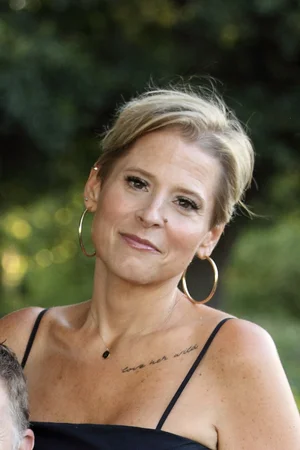
The Long Way Home: Jordan's Story
A Stories & Survival feature from Emerging Whole.
Editor's note: This is one person's account, shared with permission and edited for clarity and anonymity.
Content note: This story touches on childhood sexual abuse, addiction, homelessness, and family separation. If you're struggling with substance use or in crisis, you're not alone — in the U.S., call or text 988 (Suicide & Crisis Lifeline), or reach SAMHSA's free, confidential helpline at 1-800-662-4357, available 24/7.
---
From the outside, Jordan had the life people often envy. A craftsman house with a porch swing. A wife, Nadia, who still reached for her hand at stoplights. Three kids under seven, loud and sticky and adored. She ran the school fundraiser and remembered everyone's coffee order. If you'd asked her, she'd have told you she was fine. She'd have believed it, too.
What nobody saw was how hard she worked to keep it that way.
Jordan had learned young that safety was something you manufactured. At fifteen, a gymnastics coach — a man the whole town trusted, a man who was supposed to keep her safe — crossed a line no adult should. She never told anyone. She trained harder instead. Straighter A's, tighter schedules, a dependable smile. If she was perfect, nothing could else touch her. That was the deal she made with herself, and she kept it for twenty years without ever saying it out loud.
Then one ordinary Tuesday, looking for the spare phone charger, she found something her wife, Nadia, had been keeping out of sight.
She didn't understand it at first; the little bag, the residue, the careful hiding. When it clicked, the floor tilted. The woman she'd built a life with had a whole secret self, a meth habit tucked into the margins of their marriage. Every late night "at work," every mood Nadia explained away…the betrayal was enormous. But underneath it something older and worse woke up: that fifteen-year-old’s certainty that the ground could open under you at any second, and that no one was coming.
She sat on the bathroom floor for a long time. And then, in a decision she still can't fully explain, she didn't confront Nadia. She tried it herself.
People who haven't lived it want that moment to make sense, to have a villain or a clear mistake. It's simpler and sadder than that. For the first time in twenty years, the vigilance switched off. The coach, the secret, the crushing work of holding everything together, all of it went quiet. It felt, briefly, like relief. Like rest. That's the cruel trick of it: the thing that ends up taking everything often shows up first disguised as the thing that finally helps.
The quiet didn't last, and chasing it cost more each time.
The spiral was fast — faster than anyone around her could track. Within months the mother who never forgot a coffee order was forgetting to pick up her kids. The shame was unbearable, and shame, it turns out, is excellent fuel for addiction. She started believing the lie that lives at the center of so many of these stories: they're better off without me. One morning, convinced she was doing her family a mercy, she packed a bag and walked out. Leaving them was the worst thing she ever did and, in the warped math of active addiction, it felt like the only loving thing left.
The street took her the way it takes a lot of people; gradually, then all at once. Couches, then cars, then a tent under an overpass. Somewhere in there the meth gave way to opioids, which numbed a deeper register of pain and pulled her further down. Years blurred. She was surviving hour to hour, and survival that raw doesn't leave much room for anything else. If you'd passed her on the sidewalk, you might have looked away. Most people did.
Here is the part the envy-worthy version of her life never included: getting out took more than one try.
She went to rehab. She relapsed. She went back. She relapsed again. From the outside, that can look like failure, like she wasn't serious. It wasn't. Recovery is rarely a straight line, and for a nervous system shaped by trauma, the pull back toward the old escape is not weakness — it's a wound doing what wounds do until they're actually tended. Each stint put something in her she couldn't see yet. She was learning, in pieces, what didn't work, which is how a person eventually finds what does.
What finally held was quieter than she expected. She felt as if she’d tried every 12-step meeting, rehab facility, and sober living community within a hundred mile radius.
Somewhere along the way she landed in a LifeRing meeting, mostly because a rehab counselor suggested it and she had nothing left to lose. She'd bounced out of other programs. Being told to surrender to a higher power sat wrong in a body that had already been made small by someone with power over her. Being handed a label to wear for life felt like one more cage. LifeRing didn't ask for any of that. It's secular, and it's built on three plain ideas — sobriety, secularity, and self-direction — and one that cracked something open in her: that the sober person she was trying to become wasn't a stranger she had to build from nothing. That person was already her. Her Sober Self, buried but intact, waiting under the wreckage.
The meetings didn't traffic in shame or scripture. They asked, simply, how was your week — and listened. Week by week, she started answering honestly. She built her own recovery plan instead of inheriting someone else's. For a woman who'd spent her whole life being told what safety required, choosing her own path was its own kind of medicine.
Getting clean was the beginning, not the end. She still had to become someone her kids could count on, and that took years, not a montage.
She got a job, then a better one, and eventually a career she was proud of. She got an apartment with a door that locked and a second bedroom she furnished one paycheck at a time, for overnight visits with kids she wasn't yet allowed to have. She did the trauma work she'd dodged since she was fifteen, finally saying out loud what she'd never told a soul — and learned that the thing she'd been running from could be faced without swallowing her whole.
And she fought for her children. Not in one dramatic courtroom moment, but in the grinding, unglamorous way it actually happens: supervised visits, drug tests, caseworkers, patience she didn't know she had. Trust, once broken that badly, comes back slowly or not at all, and she had to earn every inch of it. Some days the door stayed shut. She kept showing up anyway.
Today Jordan is sober, employed, and slowly, carefully back in her kids' lives — a little more each season. She is not a before-and-after photo. She's a woman who lost nearly everything, including herself, and walked the long way back to find that the self she thought she'd destroyed had been there the whole time.
Jordan found her footing with LifeRing Secular Recovery, a secular, self-directed recovery community. You can learn more at [lifering.org](https://lifering.org).
If you're on that road right now — trauma you never named, a substance that promised rest and took everything, a family you're afraid you've lost — Jordan wants you to know the thing she needed years to believe: the version of you that gets through this isn't someone you have to become from scratch. She's already in there.
---
ABOUT THE AUTHOR
Amanda Scott-Telford is a Certified Trauma-Informed Addiction Recovery Coach and Certified Mental Wellness Coach (CPD/IPHM) and the founder of Emerging Whole — an evidence-based platform offering sober coaching, addiction recovery coaching, trauma-informed support, and practical resources for people healing from addiction, substances, maladaptive behaviors, trauma, and mental health challenges.
Emerging Whole is secular, non-programmatic, and grounded in neuroscience, CBT, and trauma-informed care.
→ Work with Amanda: emergingwhole.org/appointments
→ Resources we love: emergingwhole.org/resources
You're not broken. You're becoming whole.