Your Body Knows Before Your Brain Does
Managing Urges in Recovery With the ABC-DE Method
Written by Amanda Scott-Telford, Trauma-Informed Recovery and Wellness Coach, IPHM
I want you to think about the last time you had a strong urge. Not the story you told yourself about it afterward—the actual moment it showed up. Was the first thing you noticed a thought? Or was it something in your body—a tightness in your chest, a knot in your stomach, a restlessness in your legs that wouldn’t quit?
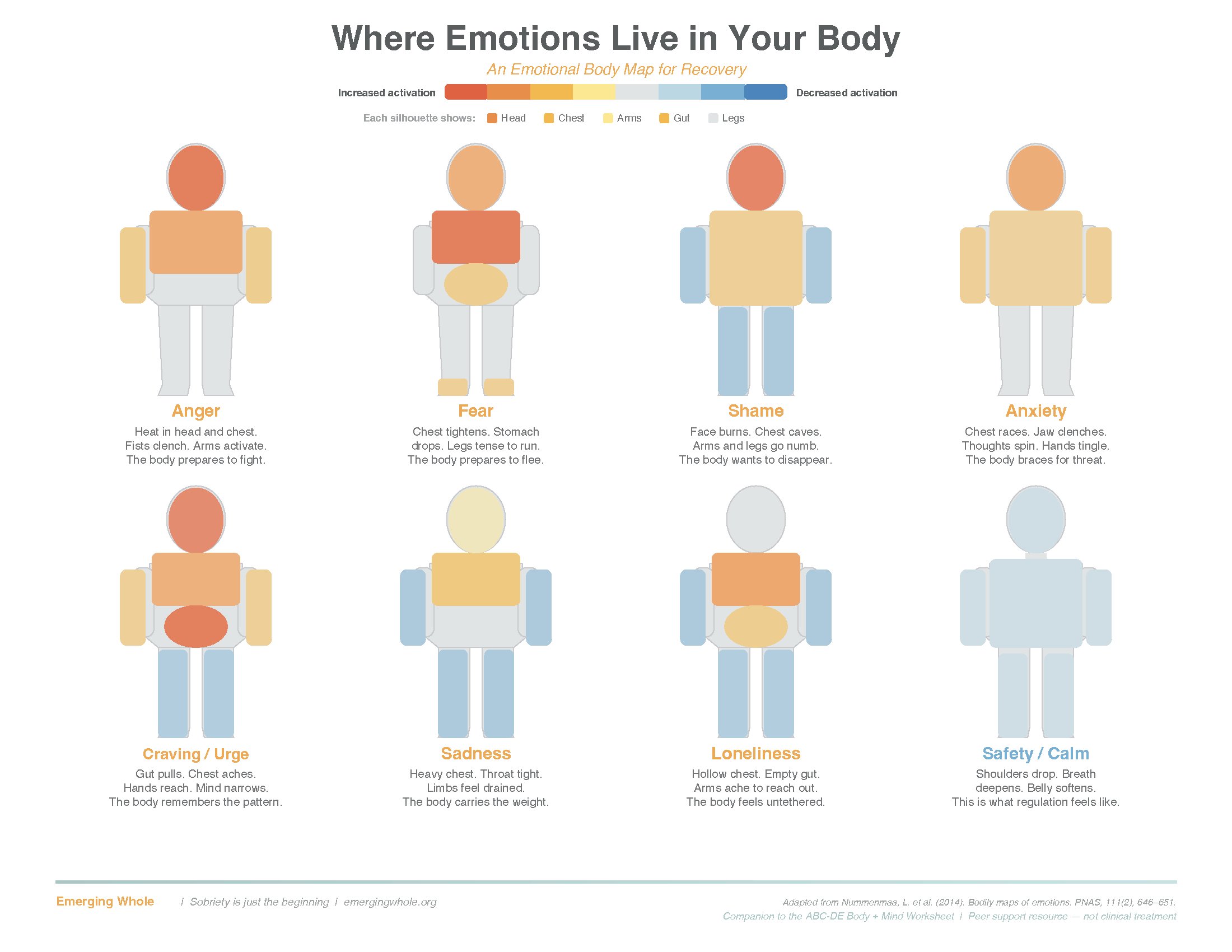
For most of us, the body sounds the alarm before the brain even gets the memo. And that’s exactly why managing urges in recovery requires more than thought work alone. It requires listening to your body, too.
The ABC-DE Method: A Powerful Urge Management Tool
If you’ve spent any time with cognitive behavioral therapy, you may already know the ABC-DE framework. It’s one of the most effective tools for managing urges in recovery because it slows you down and helps you trace the chain reaction: A is the Activating Event (what happened), B is the Beliefs that fired (what you told yourself), C is the Consequences (emotions, urges, behaviors), D is Disputing those beliefs, and E is finding an Effective new belief (Beck, 2011).
It’s structured. It’s evidence-based. And it works. But here’s the problem: most versions of the ABC-DE worksheet only ask what you were thinking.
What’s Missing: Your Body Is Carrying Half the Story
Research on interoception—our ability to sense what’s happening inside our bodies—shows that people recovering from substance or maladaptive behaviors often have a harder time reading internal physical signals (Paulus et al., 2019). We learned to override them. To push past the tightness, numb the sensation, ignore the warning. Many of us learned to live “from the neck up,” disconnected from the body’s intelligence—and that disconnection often started as a survival strategy (McBride, 2018).
But in recovery, that disconnection becomes its own problem. You might be able to identify the thought behind an urge using a standard ABC-DE worksheet, but you completely miss the clenched jaw that showed up ten minutes earlier. You might dispute the belief at step D, but your nervous system is still running the old pattern at full speed. Without body awareness, you’re doing the ABC-DE work with only half the data.
Body-Based Coping Skills Meet the ABC-DE Framework
That’s why I built a different version of the ABC-DE worksheet—one that asks what your body is telling you at every single step.
At step A, you don’t just describe what happened—you notice where you felt it first. Chest, stomach, jaw, hands. At step B, you check whether your body felt unsafe even when you were physically safe. At step C, you rate the physical intensity and ask whether the urge felt more like a sensation than a thought. At step D, you take three slow breaths and ask what your body actually needs—rest, movement, connection, safety—instead of what the craving demands. And at step E, you don’t just write a new belief. You notice what safety actually feels like in your body, so you can find your way back to it.
This is what happens when you combine a proven CBT urge management tool with somatic awareness. You stop trying to think your way out of something your body is still holding onto. You start working with your whole experience.
Your Nervous System and Cravings: Old Patterns, New Practice
Here’s what makes this approach different from other body-based coping skills: the ABC-DE framework gives you structure. It’s not just “notice your body.” It’s “notice your body at the exact moment you’re also examining your beliefs—so you can see the connection between the thought, the sensation, and the urge.”
Over time, that practice builds interoception—your ability to sense and interpret what’s happening internally. And the research is clear: people who develop stronger interoceptive awareness have better outcomes in recovery (Paulus et al., 2019). Not because they’re tougher. Because they can read the signal before it becomes a crisis.
Managing urges in recovery isn’t about white-knuckling through. It’s about getting curious. It’s about pausing long enough to notice your shoulders are up by your ears before you reach for your destruction of choice. It’s about learning that safety has a physical feeling—and that you can come back to it on purpose.
Your body is not a problem to solve. It’s a partner in this process. And combining the ABC-DE method with body awareness might be the most important shift you make in managing urges in recovery.
Ready to try it?
Download the ABC-DE Body + Mind Urge Worksheet and start working with your whole experience—not just the part that lives in your head.
Citatations
Beck, J. S. (2011). Cognitive behavior therapy: Basics and beyond (2nd ed.). Guilford Press.
McBride, H. L. (2018). The wisdom of your body: Finding healing, wholeness, and connection through embodied living. Brazos Press.
Paulus, M. P., Stewart, J. L., & Haase, L. (2019). Treatment approaches for interoceptive dysfunctions in substance use disorders. Current Opinion in Psychiatry, 32(4), 324–331.