Going No Contact
How I Finally Chose Myself After 40 Years
Written by Amanda Scott-Telford, Trauma-Informed Recovery and Wellness Coach, IPHM
The first time I learned my truth didn't matter, I was four years old.
I was at daycare, in the big kid playroom for the first time. A boy a couple years older told me he wished we were naked. I was a big pretender, so I said, "Just pretend we are." He took it as an invitation, pushed me against a cold wall, and began rubbing his body against mine. When the daycare workers found us, I was the one pulled aside. I was the one made to feel shame. At four, I learned that whatever happened to my body would somehow be my fault.
By seven, I had already learned to carry secrets in my small body.
My stepfather had declared he hated liars and secrets, had made us all promise—small children—that we would never keep anything from him. This despite the fact that I'd been keeping his secret since I was five: I'd overheard my mom on the telephone one day telling her best friend he was in prison. I carried that knowledge silently, even creating stories for my little brothers about where he might be when he was away, a weight no child should bear. The man who demanded total transparency from children had built our entire relationship on a lie. But his rules never applied to himself.
So when he challenged me one evening in the kitchen, insisting I couldn't keep a secret, I proved him wrong. I proudly told him about the shoes Mom had on layaway for me, the ones she'd asked me not to mention.
What followed was hours of interrogation. They sat me in the narrow breakfast nook, trapping my small body on a bench, and questioned me like I was a criminal. I asked for water and my stepfather said not until I admitted I'd lied. I asked to go to bed and they refused. My mother's eyes shifted from fury to something more insistent, almost encouraging, as she offered me an out: "Maybe you dreamed it?"
I felt sweat drip under my arms for the first time in my life. Exhausted and desperate, my seven-year-old brain started to wonder—if Mom says it didn't happen, maybe it didn't. Maybe I had dreamed it.
But I hadn't. My mother had simply chosen to protect herself—her shopping habits, her secrets from my stepfather—over her seven-year-old daughter. She threw me under the bus to cover her own lie, and in doing so, reinforced what I'd already been taught: my reality could be rewritten by the adults who were supposed to protect me.
The sexual abuse at home started before I could fully understand what it was. My oldest stepbrother cornered me in the basement and demanded to see my private parts. When I told my mother, she half-laughed and said I should just avoid going in the basement with him anymore. Problem solved. Except it wasn't my problem to navigate—I was a child.
Later, when that same stepbrother told another to hold me down while he climbed on top of me, grinding his body against mine, I knew instinctively I wouldn't be believed. I could smell his rank breath, feel his hands on my small body, hear the laughter from whoever was watching. I knew if I told, I would be called dramatic. I would be told to stop complaining. It would be my fault.
The environment itself was toxic—ubiquitous pornography, crude comments about bodies, a culture where I was both invisible and too visible. My stepfather commented on my developing breasts, calling them "tiny titties" and telling me how chubby I was getting. When my half-brother came into my bed during visits, rubbing himself against me in the dark while whispering that he loved me, I finally worked up the courage to tell my mother one morning. Her response was to explain how mean his stepmother was to him, how he probably just didn't understand the difference between "sister love and girlfriend love."
The message was clear: my body existed to absorb the confusion and desires of the boys and men around me. My discomfort was secondary to their needs.
“For years, I buried it. I moved across the country, got married, had children. The memories surfaced in therapy, in quiet moments, in nightmares. By 2015, I couldn’t carry them silently anymore.”
I wrote an email to all of them—my stepbrothers, my half-brother, my brothers, my stepfather, my mother, even my sisters-in-law. I told them what I remembered. My oldest stepbrother telling another to hold me down. My half-brother coming into my bed. The environment that allowed it all to happen. I even gave them an out: "We were young. Our environment wasn't healthy. There was a culture of toxic sexism, sexual inappropriateness, and ever-present pornography in our home."
It didn't matter. My oldest stepbrother called me a fucking liar. Another made a joke about penis size. My stepfather smugly declared he certainly hadn't done anything inappropriate—as if that meant anything. As if he hadn't been sexually suggestive toward me, touched my breast at 13, groomed me. The worst responses were the silences. My brother, thirteen months younger, the one I'd felt closest to my entire life—nothing. My baby brother, who I protected and loved —nothing. Their silence felt like a betrayal and a devastating heart break.
And my mother? Rather than respond to me, she sent an email to the nonprofit organization I worked for, accusing me of being a liar, suggesting I should be fired. My own mother tried to destroy my livelihood rather than acknowledge what had happened to me.
I was pregnant, with no family in a new place, but I blocked them all. Told my mother not to contact me. Her response: "Have a nice life."
One person validated me—my youngest stepbrother's wife. She said she believed me. That my stepfather had made inappropriate comments about her body, asked her husband about their sex life. It was a small consolation, but it meant everything. Why could this woman, essentially a stranger, see the truth when my own mother refused?
The years that followed were a slow unraveling of no contact, then tentative reconnection. When I got divorced, my mother and I cautiously rebuilt something and she supported me in ways I'm grateful for. We never talked about the email, not really. I visited home for the first time in a decade when my cousin got married a few years later.
The night before the wedding, my stepfather baited me, catching me alone after dinner. "(Performative sigh) I'm really not looking forward to tomorrow," he said. When I asked why, he explained matter-of-factly that he didn't think two people of the same sex should get married—this despite his own mother living with her female partner for twenty-five years. I knew he was trying to draw me into an argument and I refused to take the bait. I got up and walked away.
At the reception, my mother enjoyed herself and drank a bit too much wine. I watched her get that glazed, overly assertive look she gets when she's had too much but still wants to be taken seriously. I watched her beg my stepfather to dance with her.
He looked at her with disgust and contempt, refusing. Then he left her there—at her nephew's wedding—and drove home.
What followed was my stepfather's most theatrical manipulation yet. He claimed his cancer had returned. A cancer that never existed. This man who once faked a stroke. Who told business associates he survived liver cancer when he'd actually had a routine procedure. Who claimed to have served in Vietnam despite his age making it nearly impossible and his ex-wife confirming he never left the country during that time. Stolen valor, anyone?
My mother told me he'd broken down crying the day after abandoning her at the wedding, confessing about secret trips to cancer specialists in Florida. When I told her he was lying—that he absolutely did not have cancer, that he wouldn't be able to be in all of these public places while undergoing secret chemo treatments, that he just needed an excuse for being a colossal asshole, that this was pretty much in line with his character as a narcissist—she said, "Yeah, you're probably right."
And then she stayed with him anyway.
Around this time, my young daughter was facing a potential cancer scare. Real illness, actual fear. And this man was weaponizing fake cancer for sympathy and cover. I told my mother I wished he did have cancer. That I hoped he would die painfully and slowly.
She admonished me for saying that. Protected him, again, over me.
The final straw came nine months after that wedding.
My mother texted my son—eighteen at the time—inviting him to go on a fishing trip with my brothers, stepbrothers, and stepfather. She knew how much my son loved fishing. She dangled it like bait.
I lost it.
Our relationship had been low contact, cordial, telephone-only for the past nine months. But I couldn't hold back any longer. I sent her a text:
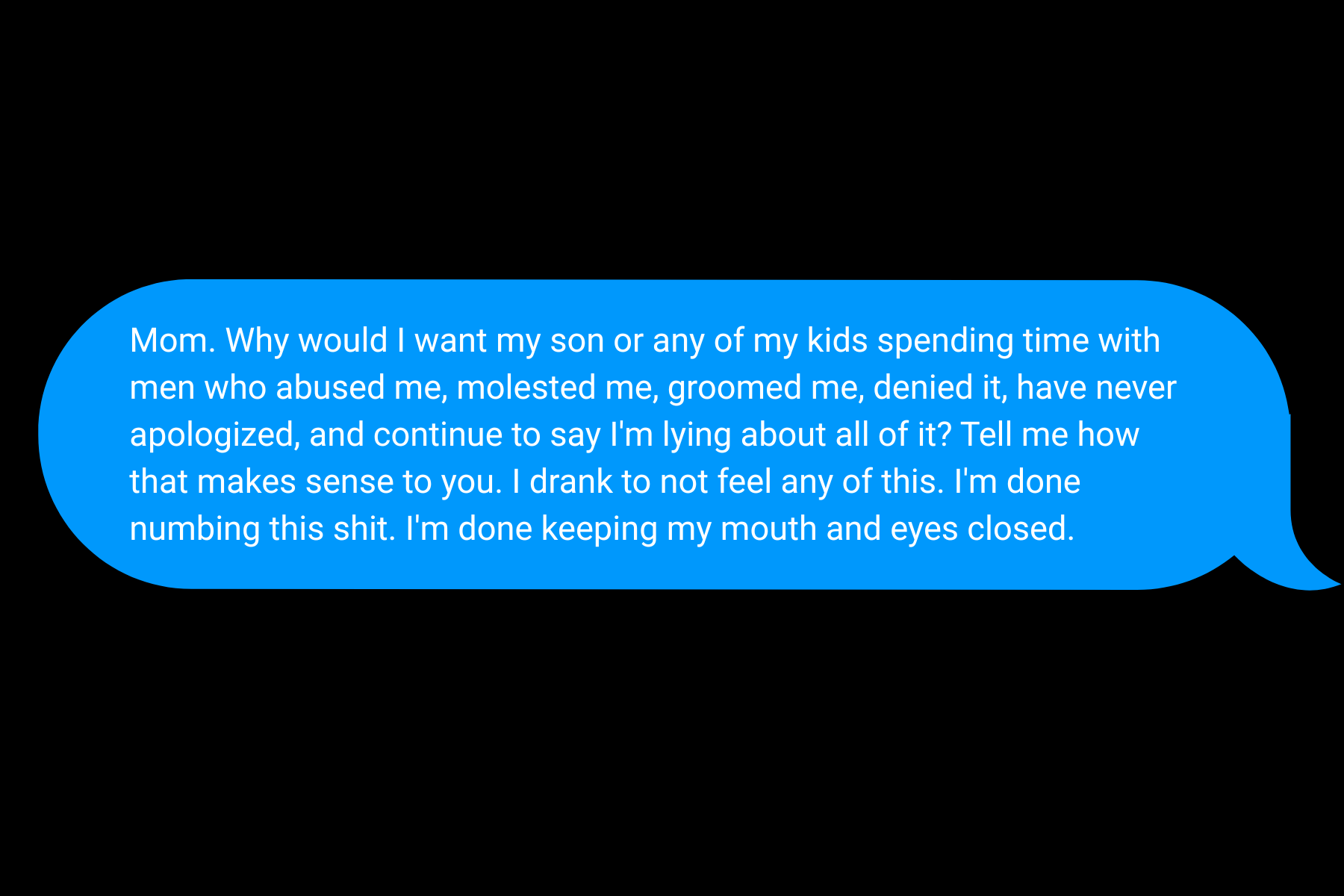
Silence followed. I didn't send a Mother's Day card. I didn't send a birthday card.
Then, months later, a greeting card arrived in the mail from my mother. On the outside, it read: "I'm So Proud of All You've Accomplished." Inside: "But don't forget you couldn't have gotten there without ME."
I didn't know Hallmark had a card category for passive aggression.
Tucked inside was a handwritten note: "Amanda, words are like weapons, they wound sometimes. I wished you'd stop reminding me of how I didn't protect you. I need a break."
She needs a break? And was she quoting Cher?
It was laughable. And I was done.
The pattern was always the same: my truth didn't matter, my pain was inconvenient, and my mother would always choose the men in that house, or more accurately, her own self-preservation. She'd chosen herself when I was seven, interrogating me about shoes until I doubted my own reality. She'd chosen herself when I reported abuse and was told to just avoid basements and tolerate confused half-brothers. She'd chosen her comfort when my stepfather psychologically tortured me as a teenager and hit me and groomed me. And when I finally spoke my truth as an adult…she tried to get me fired. She chose herself when she stayed with the man who left her at a wedding and lied about cancer as an excuse. And she chose herself again when she invited my son to be exposed to their fold, as if decades of abuse could be papered over with a fishing trip.
Some relationships cannot survive that kind of choosing. Distance is not punishment—it's preservation. Going no contact wasn't about anger, though there was plenty of that. It was about finally accepting that the mother I needed had never existed, and the mother I had would never protect me. She couldn't. She'd proven it over and over, for forty years. I simply couldn’t let any of them hurt me anymore.
The silence now is mine to keep. And there's peace in that knowledge. That this choice was mine.
I don't hear constant criticism from anyone in my life anymore: about my weight, my kids, where I live and how I live, anything. Looking back, I cannot believe I endured that level of abuse for so much of my adulthood. But I try not to be too angry at myself. I didn't know I deserved better. I thought this was what family meant, that this is how people who love you treat you.
When we know better, we do better…and we demand better, right?