Harm Reduction: A Path Forward When Abstinence Isn't the Starting Point
Written by Amanda Scott-Telford, Trauma-Informed Recovery and Wellness Coach, IPHM
Here's the truth much of recovery culture doesn't always want to acknowledge: not everyone is ready for abstinence, and that's okay. Harm reduction meets people exactly where they are—without judgment, without ultimatums, and without pretending that one approach fits everyone.
For years, the conversation around substance or maladaptive behavior has been framed as all-or-nothing. Either you're sober or you're failing. But what if there's a middle path? What if reducing harm—even while still using—is its own form of progress?
Let's Define the Terms
Abstinence means complete cessation—no substances, no engagement with the problematic behavior. For many people, this is the goal and the path that ultimately works best for their recovery. It's the approach most traditional treatment programs emphasize.
Moderation involves controlled, limited use—attempting to manage a substance or behavior rather than eliminate it entirely. This works for some people with some substances, though research shows it's often not sustainable for those with severe dependencies.
Harm reduction is different from both. According to the National Harm Reduction Coalition (2020), it's a set of practical strategies aimed at reducing negative consequences associated with drug use—without necessarily requiring abstinence as the endpoint. It's also a movement for social justice built on respect for the rights of people who use drugs.
The key distinction: harm reduction focuses on preventing death, disease, and suffering—not on (necessarily) achieving sobriety. It accepts that substance use exists in our world and aims to minimize its harmful effects rather than simply condemn it.
Considering a harm reduction strategy? Explore this worksheet. Harm Reduction Inventory
What Harm Reduction Actually Looks Like
Harm reduction exists on a spectrum, from medical interventions to everyday choices. Some examples include: syringe access programs that prevent disease transmission, Naloxone distribution that saves lives during overdoses, Naltrexone for alcohol cravings, Suboxone for opioid withdrawal, and safer consumption spaces where people can use substances under medical supervision.
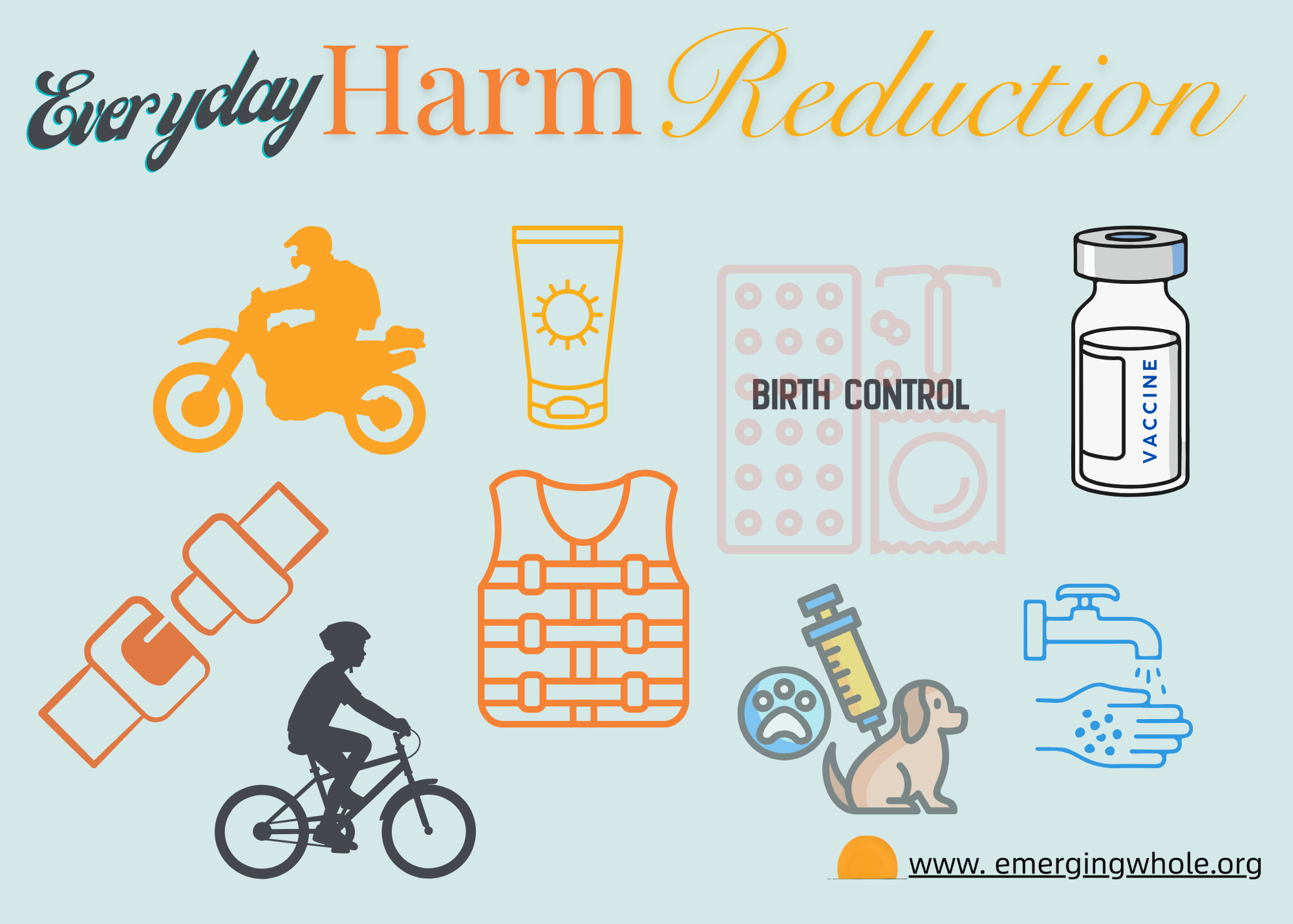
But harm reduction also shows up in smaller, personal decisions. Someone might switch from hard liquor to beer, reducing their overall alcohol intake. Someone else might start using at home instead of alone in public spaces, increasing their safety. These aren't failures—they're harm reduction in action.
The Smoking and Vaping Question
One of the more controversial harm reduction conversations involves nicotine. Some people in recovery from alcohol or other substances turn to smoking, vaping, or other nicotine products as a substitute. Is this harm reduction?
From a user perspective, the answer can be yes (Maier, 2023). If using nicotine replaces a substance associated with high mortality and acute behavioral risks (like alcohol, cocaine, meth) with something that, while not safe, generally presents lower risks of immediate death, violence, or severe organ failure. The hand-to-mouth ritual can replace the behavioral habit of drinking, and nicotine provides a mild stimulant effect that may satisfy some cravings.
However, this is where honest conversation matters: nicotine and smoking/vaping are not risk-free.There's potential for lung disease and nicotine dependency. Some research suggests nicotine and alcohol can reinforce each other, making this swap ineffective for certain people. And many health organizations don't formally endorse vaping as a harm reduction tool for alcohol use.
The bottom line: if your choice is between drinking yourself into a dangerous situation or vaping instead, harm reduction principles would suggest the latter causes less immediate danger. But it's a personal calculation, not a universal prescription.
Harm Reduction Beyond Substances
Here's something that might reframe your thinking: we already embrace harm reduction everywhere in life. Seatbelts don't prevent accidents—they reduce harm when accidents happen. Helmets don't stop falls. Sunscreen doesn't keep you out of the sun. We understand that people will engage in risky activities, and we build systems to make those activities safer.
The same logic applies to substance use, compulsive behaviors, and the messy reality of human decision-making. Harm reduction isn't about condoning or enabling. It's about acknowledging reality and choosing compassion over judgment.
Where Does This Leave You?
If you're working toward abstinence, that's a valid and powerful goal. If you're not there yet—or if complete abstinence isn't your path—harm reduction offers another framework for moving forward. The goal is quality of life and well-being, not a one-size-fits-all approach to recovery.
Small gains matter. Staying alive matters. Reducing risk matters. And meeting yourself where you actually are? That's where real change begins.
Considering a harm reduction strategy? Wonder how to assess a risky situation before it happens?
Explore this worksheet. Harm Reduction Inventory
Sources
· Maier, J. T. (2023, October). Is vaping harm reduction? Psychology Today.https://www.psychologytoday.com/us/blog/philosophy-and-therapy/202310/is-vaping-harm-reduction
· National Harm Reduction Coalition. (2020). Principles of harm reduction. https://harmreduction.org
· Recovery Answers. (n.d.). Drug and alcohol harm reduction. Recovery Research Institute.https://www.recoveryanswers.org/resource/drug-and-alcohol-harm-reduction/
· Broadhead, R. S., Kerr, T. H., Grund, J. C., & Altice, F. L. (2002). Safer injection facilities in North America: Their place in public policy and health initiatives. Journal of Drug Issues, 32(1), 329-355. doi: 10.1177/002204260203200113
· Centers for Disease Control and Prevention (2007). Syringe exchange programs: United States, 2005. Morbidity and Mortality Weekly Report, 56(44), 1164-1167.
· Gibson, D.R., Flynn, N.M., & Perales, D. (2001). Effectiveness of syringe exchange programs in reducing HIV risk behavior and HIV seroconversion among injecting drug users. AIDS, 15(11), 1329-1341.
· Heimer, R. (1998). Can syringe exchange serve as a conduit to substance abuse treatment? Journal of Substance Abuse Treatment, 15(3), 183-191.
· Kerr, T., Tyndall, M. W., Lai, C., Montaner, J. S. G., & Wood, E. (2006). Drug-related overdoes within a medically supervised safer injection facility. International Journal of Drug Policy, 17(5), 436-441. doi: 10.1016/j.drugpo.2006.05.008
· Leslie, K. M. (2008). Harm reduction: An approach to reducing risky health behaviours in adolescents. Paediatrics & Child Health, 13(1), 53-56. doi: 10.1093/pch/13.1.53
· Lindsey, V. V. (2003). Primary, secondary and tertiary youth prevention programs. Journal of Addictive Disorders.
· MacPherson, D. (2001). A framework for action: A four-pillar approach to drug problems in Vancouver. Drug Policy Report.
· Maxwell, S., Bigg, D., Stanczykiewicz, K., & Carlberg-Racich, S. (2006). Prescribing naloxone to actively injecting heroin users: A program to reduce heroin overdose deaths. Journal of Addictive Diseases, 25(3), 89-96. doi: 10.1300/J069v25n03_11
· Wilson, D. P., Donald, B., Shattock, A. J., Wilson, D., & Fraser-Hurt, N. (2015). The cost-effectiveness of harm reduction. International Journal of Drug Policy, 26(1), S5-S11. doi: 10.1016/j.drugpo.2014.11.007
· Wood, E., Tyndall, M. W., Zhang, R., Stotlz, J., Lai, C., Montaner, J. S. G., . . . Kerr, T. (2006). Attendance at supervised injection facilities and use of detoxification services. New England Journal of Medicine, 354, 2512-2514. doi: 10.1056/NEJMc052939
· World Health Organization (2004). Policy brief: Provision of sterile injecting equipment to reduce HIV transmission. Policy brief.