Finding Balance in Recovery: The Whole Life Wheel
Written by Amanda Scott-Telford, Trauma-Informed Recovery and Wellness Coach, IPHM
So, you did the work, you made the changes, and now... you're supposed to just figure out how to live? Unfortunately, nobody hands you a manual for rebuilding an entire life.
Here's what I've learned: Recovery isn't just about stopping a behavior. It's about creating a life so full and satisfying that you don't need to escape from it anymore. And that requires something most of us never learned how to do—balance.
The Roots of a Balanced Life
Think of your life like a tree. A tree with roots spreading in only one direction will topple in the first strong wind. Stability comes from growing roots in multiple directions—even the ones that feel harder to reach.
The Life Balance Wheel is a tool that helps you see where your roots are deep and strong, and where they might need more attention. It's not about perfection (please, let's retire that word). It's about building something that can weather the storms.
The Six Dimensions of Life Balance
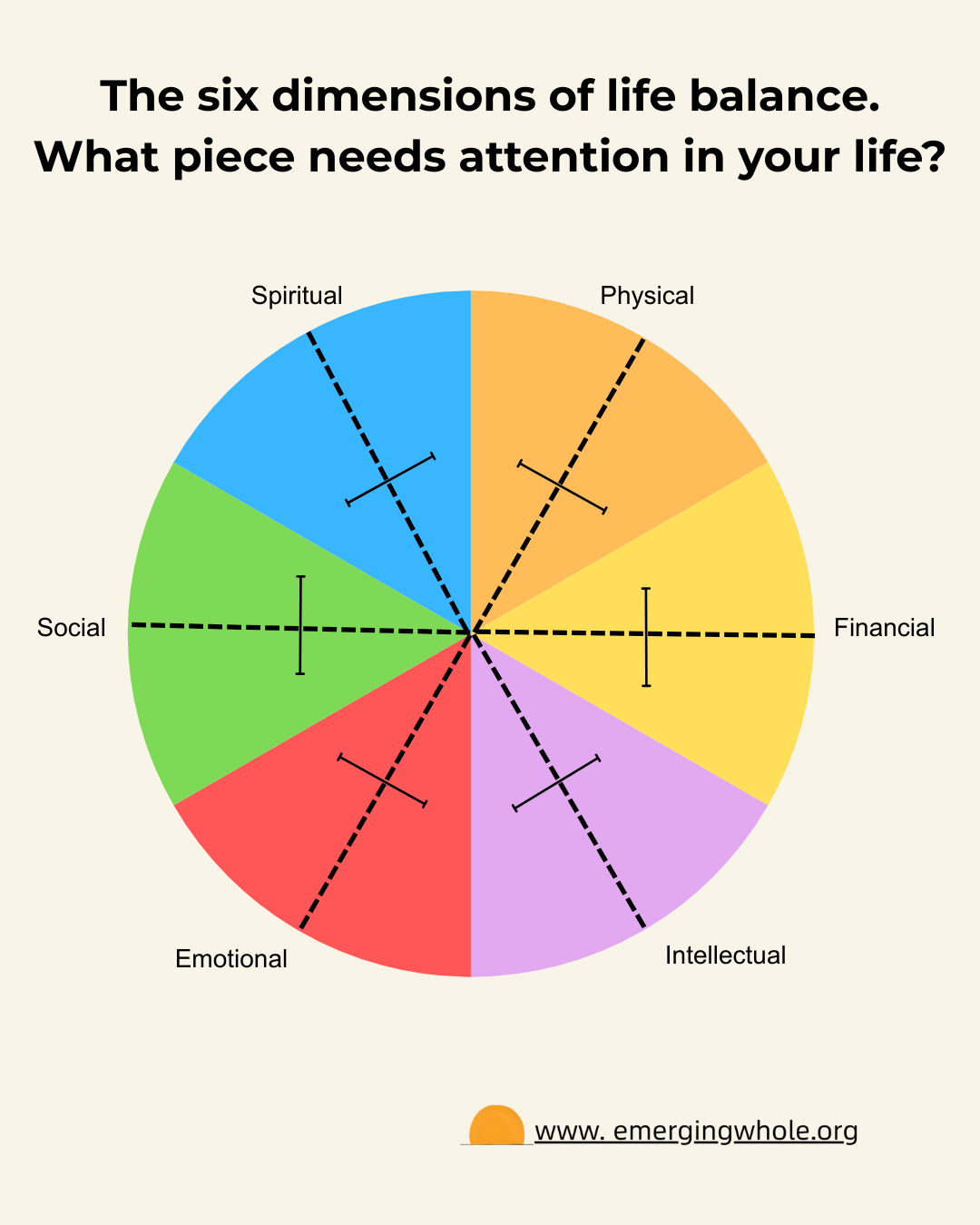
Research from the University of California, Irvine identifies six key areas that contribute to overall wellbeing (University of California, Irvine Student Wellness Center, 2015):
Physical: Your body—exercise, nutrition, sleep, and how you care for your physical health.
Financial: Your relationship with money—earning, spending, saving, and the security (or stress) it creates.
Intellectual: Your mind—learning, curiosity, professional growth, and mental stimulation.
Emotional: Your inner world—stress management, self-awareness, and how you process feelings.
Social: Your connections—relationships, boundaries, belonging, and community.
Spiritual: Your meaning—purpose, values, practices that ground you, and what gives your life significance.
Why This Matters in Recovery
When we were caught up in our substance or maladaptive behavior of choice, these areas became wildly imbalanced. Maybe we neglected our health, damaged relationships, ignored our finances, or lost our sense of purpose entirely. Our roots were shallow, tangled, reaching desperately in one direction.
Recovery gives us the opportunity to rebuild intentionally. But here's the thing—you can't work on everything at once. The Life Balance Wheel helps you see clearly: Where are my roots strong? Where do I need to grow deeper?
When we connect our values (what matters most) with our life areas (how we spend our time and energy), we make more consistent decisions, strengthen our motivation for change, and recognize when our actions don't align with who we want to be (Strobl, 2024).
Creating Positive Change
For areas where your roots feel shallow:
- Set small, achievable goals
- Focus on one area at a time
- Celebrate small growth
- Remember: progress, not perfection
The goal isn't perfectly symmetrical roots. It's building a life stable enough to stand—a life you don't need to numb yourself to survive.
I've included a Whole Life Wheel worksheet below to help you create your own personalized assessment. Take twenty minutes this week to honestly evaluate where you are. No judgment, just awareness. Because you can't grow what you can't see.
Citations
Strobl, P. (2024, June 17). *How values shape your life: Insights from experts in personal development*. Confide Coaching. https://confidecoaching.com/how-values-shape-your-life/
University of California, Irvine Student Wellness Center. (2015). *Assessing your life balance*. https://studentwellness.uci.edu/wp-content/uploads/2015/04/Assessing-Your-Life-Balance.pdf