When a Storm Hits, Run Toward It
Why moving through feelings is the only way out
Written by Amanda Scott-Telford, Trauma-Informed Recovery and Wellness Coach, IPHM
There’s a phenomenon that happens on the Great Plains that most people don’t know about.
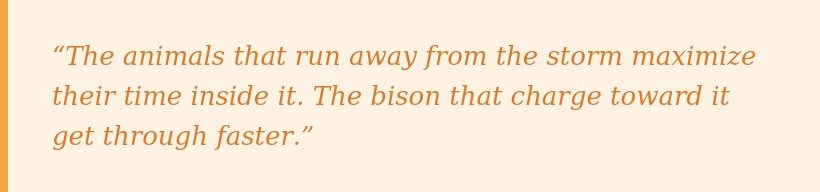
When a storm rolls in, most animals — horses, cattle, deer — turn and run away from it. And here’s the problem with that: the storm is faster. So the animals that run away from it end up running alongside it, inside it, for a long time. They maximize their time in the storm by trying to escape it.
Bison do something different.
Bison turn and charge directly toward the storm. They run straight into it. And because they move into it rather than with it, they minimize the time they spend in discomfort. They get through it faster.
I think about this a lot. Because it’s one of the most accurate metaphors for what happens when we try to outrun a hard feeling.
What Happens When We Run
When a difficult emotion shows up — grief, shame, anger, fear, that particular hollow ache that doesn’t have a name — the most instinctive thing to do is move away from it. Distract. Numb. Stay busy. Have one more drink, scroll for another hour, pick a fight so the energy has somewhere to go.
This is not a character flaw. It’s neuroscience. The brain is wired to protect you from pain, and in the short term, avoidance does exactly that. It works — until it doesn’t.
What research on emotional suppression consistently shows is that unfelt emotions don’t disappear. They get stored. In the body, in the nervous system, in the patterns we run on autopilot. That tight feeling in your chest that shows up for no apparent reason. The way a small frustration can suddenly feel enormous. The emotional flooding that seems out of proportion to what just happened. These are the feelings you ran from. The storm was always faster.
What “Processing” Actually Means
Processing emotions is a phrase that gets used a lot without anyone explaining what it actually involves. It doesn’t mean analyzing your feelings into submission. It doesn’t mean crying until you feel better (though sometimes that’s part of it). It doesn’t mean getting over something or reaching a point where it no longer matters.
Processing means letting a feeling move through you. Witnessing it without either feeding it or suppressing it. Giving it just enough space to do what it came to do.
Emotions are, at their core, physiological events. When something threatening or significant happens, the body responds — cortisol, adrenaline, a cascade of neurological signals that activate long before conscious thought arrives. The feeling comes first. The story about the feeling comes second.
When we skip the feeling and go straight to the story, or skip both and go straight to distraction, the physiological activation stays stuck. The body’s alarm doesn’t get the signal that it’s safe to stand down.

This is why somatic and body-based approaches to healing can be so powerful. They work with the body’s own language — sensation, breath, movement — rather than trying to think your way past something that was never just a thought.
The Difference Between Avoiding and Pacing
Here’s something important, because nuance matters: there is a difference between avoiding a feeling and pacing yourself through it.
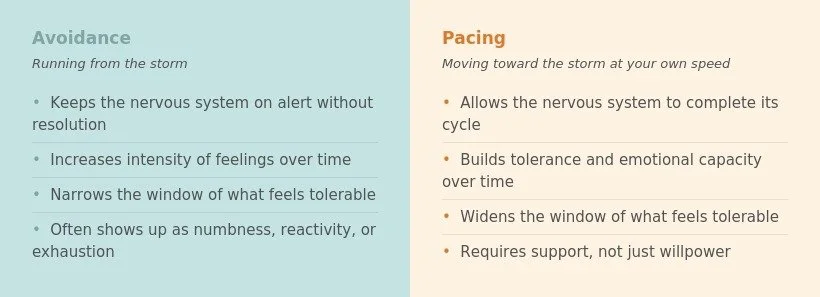
Avoidance is the strategy that keeps you on the outside of the storm indefinitely. It keeps the alarm running in the background, all the time, quietly. It may look like functioning fine on the surface. It often costs more than it appears to.
Pacing is different. Pacing is what happens when you recognize that a feeling is too big or too activating to work through all at once, and you make a conscious decision to approach it gradually. This is a legitimate, evidence-based strategy — especially for trauma, where the window of tolerance for sitting with difficult material is often narrow and needs to be widened slowly over time.
The question isn’t whether you feel it all right now. The question is whether you’re moving toward the storm or away from it.
How to Start Moving Toward the Storm
You don’t have to charge headfirst into the hardest thing you’ve ever felt. The bison metaphor isn’t about being fearless. It’s about direction.
Here’s what facing a feeling can actually look like:
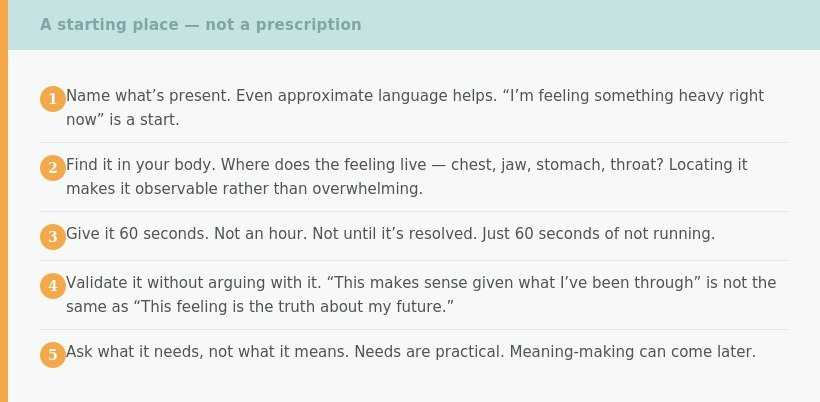
This is slow work. It is not linear. There will be storms you are not ready for yet, and that is not a failure — that’s information about what kind of support and capacity-building you need next.
You Don’t Have to Do This Alone
One of the things that makes this work possible — and sustainable — is having someone to do it with. Not someone who’ll push you into the storm before you’re ready, but someone who can help you build the tolerance to keep moving toward it, at your own pace, with your own nervous system as the guide.
That’s doing the work.
Not fixing you. Not rushing your timeline. Just helping you build the capacity to face what needs to be faced, and to come through it more whole than you went in.
Need practice? Check out the worksheet,
Citations
Chapman, B. P., Fiscella, K., Kawachi, I., Duberstein, P., & Muennig, P. (2013). Emotion suppression and mortality risk over a 12-year follow-up. Journal of Psychosomatic Research, 75(4), 381–385. https://doi.org/10.1016/j.jpsychores.2013.07.014
Gross, J. J. (1998). Antecedent- and response-focused emotion regulation: Divergent consequences for experience, expression, and physiology. Journal of Personality and Social Psychology, 74(1), 224–237. https://doi.org/10.1037/0022-3514.74.1.224
Gross, J. J., & John, O. P. (2003). Individual differences in two emotion regulation processes: Implications for affect, relationships, and well-being. Journal of Personality and Social Psychology, 85(2), 348–362. https://doi.org/10.1037/0022-3514.85.2.348
Gross, J. J., & Levenson, R. W. (1993). Emotional suppression: Physiology, self-report, and expressive behavior. Journal of Personality and Social Psychology, 64(6), 970–986. https://doi.org/10.1037/0022-3514.64.6.970
Levine, P. A. (1997). Waking the tiger: Healing trauma. North Atlantic Books.
Neta, M., & Haas, I. J. (2019). Movere: Characterizing the role of emotion and motivation in shaping human behavior. In Nebraska Symposium on Motivation (Vol. 66, pp. 1–9). Springer. https://doi.org/10.1007/978-3-030-27473-3_1
Ogden, P., Minton, K., & Pain, C. (2006). Trauma and the body: A sensorimotor approach to psychotherapy. W. W. Norton.
Porges, S. W. (2011). The polyvagal theory: Neurophysiological foundations of emotions, attachment, communication, and self-regulation. W. W. Norton.
van der Kolk, B. A. (2014). The body keeps the score: Brain, mind, and body in the healing of trauma. Viking.